

Every Civic Space Carries an Invisible Architecture.
Some People Move through it Without Ever Noticing the Walls.
Others Spend their Whole Lives Feeling for the Door.
That was the question sitting at the center of our Civic Engagement & Democracy Lab, held at Edmonton Public Library’s Stanley A. Milner branch as part of the 2026 Artivism Cohort: who actually gets a seat in civic life, who controls that, and what does it take to feel like you belong and can meaningfully participate once you’re there.
This session was also proudly hosted in partnership with Table Topics in Your Neighbourhood by Apathy is Boring, a national initiative that trains young people to host their own civic conversations with friends and family.
We opened with a land acknowledgement grounding the evening in Treaty 6 territory and amiskwacîwâskahikan, naming that whose presence in civic life has been assumed and whose has been excluded by design is itself a question shaped by land, history and power. From there, we moved into a story circle panel with seven voices spanning youth governance, gender equity advocacy, stakeholder relations, community organizing, human rights education, civic storytelling and legal access.
Opening Reflection: Our Earliest Rooms
Before the panel began, we asked participants a simple but disarming question: what’s your earliest memory of being in, or kept out of, a room where a decision was being made?
The answers, submitted anonymously, painted a strikingly consistent picture. For many, the very first room they were ever excluded from wasn’t political at all. It was home. Several participants pointed to their parents deciding where the family would move, what schools they’d attend, or what clubs and activities they’d be enrolled in, all without any say of their own. Others described family vacations planned entirely by the adults in the room, or grown-ups only family meetings where children understood decisions were happening just beyond the door.
School surfaced again and again as the first real site of civic negotiation. Participants recalled decisions about which junior high they’d attend, conversations at parent-teacher meetings that shaped their academic path, and early experiences organizing school events, sometimes as one of the only times they felt genuinely inside the room rather than outside it.
A few reflections cut even deeper into what “being in the room” can feel like even when you’re technically present:
One participant described feeling alone in advisory committees they’d been invited onto specifically because of their diverse perspective, a reminder that a seat at the table doesn’t always come with a sense of belonging once you’re sitting in it. Another offered something quietly powerful: their earliest memory wasn’t of being kept out of a room, but of not even knowing such rooms existed in the first place. That distinction, between being excluded and being entirely unaware that a door exists to be excluded from, became one of the evening’s most resonant threads.
Core Thread: What Shapes Who Gets a Seat
The heart of the panel turned to the structural question underneath all of this: what actually determines who gets a seat in civic life, and who controls that.
Panelist reflections converged on a layered answer. One panelist, a civic storyteller and community engagement researcher, grounded the conversation in practical accessibility, using a quick interactive poll to show that while most people in the room actively used municipal services like ETS transit, bike lanes, and local businesses, very few were aware that the city even runs public consultation surveys. Beyond simple awareness gaps, she pointed to concrete logistical barriers, like the fact that civic events and focus groups rarely provide childcare, forcing parents and caregivers to choose between family responsibility and civic participation. Who gets a seat, she argued, often comes down to who has the information, time, and resources to show up in the first place.
Another panelist, representing a national youth civic engagement organization, offered a broader definition of civic engagement itself, arguing that it isn’t limited to formal political power. Volunteering, staying informed, and having meaningful community conversations all count as participation. But she drew an important line between participating and actually having impact, noting that a smaller, more exclusive group still controls whose voices get heard and acted upon.
Civic participation may be open to everyone, however, real influence remains gated.
A third panelist, whose work centers gender equity in municipal governance, widened the lens further, framing access through both systemic and individual dimensions. They named how identity factors like race, disability, education level, and newcomer status shape not just who gets invited to the table, but whether someone feels safe enough to speak freely once they arrive. They also spoke to how societal bias determines who is seen as a legitimate authority, noting that marginalized individuals, even when highly qualified, often have their expertise quietly devalued. Privilege, they added, tends to put people in the right place at the right time, generating leadership opportunities almost passively for those who already hold social advantage.
Another panelist, a longtime stakeholder relations and advocacy leader, focused on the more explicit, formal gatekeeping mechanisms at play, pointing to qualifications like university education as a determinant of who is invited into decision-making spaces in the first place. He emphasized that advocating for your own issues matters, but so does taking on responsibility for bridging the gap for community members who aren’t yet in the room.
A final voice in this round, representing a youth-led legal access organization, pushed back gently on the idea that civic power requires formal access at all, framing engagement instead as a grassroots, community-driven practice. She pointed to a national letter-writing campaign that successfully pressured the federal government to reverse proposed budget cuts to Women and Gender Equality Canada as proof that regular citizens, without high-level access, can still drive real policy change through collective action.
Why We Participate
We also asked panelists and participants why they choose to participate civically at all, or why they don’t.
One panelist answered through the lens of creativity, describing civic participation as an act of imagination. Many of our democratic institutions are centuries old, she noted, and while they may still function, they don’t have to stay static. She spoke about using creative thinking to challenge inherited systems, offering the example of shifting city council meetings to evening hours so working residents could actually attend. For her, participation is about dreaming up more accessible systems rather than settling for the ones we were handed.
After her, one of our attendees jumped in and spoke candidly about being newer to civic issues, describing curiosity as their entry point. Being surrounded by people passionate about civic life sparked their own desire to learn, engage and eventually bring that knowledge back to their own community.
Among the broader group of panelists and attendees, several powerful threads emerged. Representation and role modeling came up repeatedly, especially the importance of marginalized, queer and trans youth being visibly present in public spaces so future generations have a precedent for their own involvement. Others spoke about engagement as a responsibility to amplify voices beyond their own, creating pathways for community members who face systemic barriers to participation. Several participants with international backgrounds described how experience with corrupt or unresponsive political systems abroad shaped a deep appreciation for the avenues of public feedback available here, motivating them to use every opportunity to be heard. And running underneath nearly every reflection was a shared refusal to give in to apathy or burnout, even when progress feels incremental.
As one participant put it, doing the work scared is still doing the work, because empowering even one other person makes it worthwhile.
Another spoke about showing up not only to represent themselves, but to represent voices and opinions that have historically gone unheard. One newcomer described civic participation as a second chance they weren’t willing to let pass by. And one simple reflection captured the emotional undercurrent of the whole evening: keep moving forward, even when you fall back sometimes, because giving up is never really an option.
One Action to Open the Room
The panel’s final thread turned forward, asking each voice for one concrete action that could help open the room to more people.
One panelist spoke to personal bravery, urging people to push past imposter syndrome and act despite fear or self-doubt. Formal qualifications aren’t a prerequisite for driving change, they argued. Small, tangible steps, sending an email, speaking up, sharing an idea publicly, can be the catalyst for something much bigger.
Doing it scared is still doing it.
Another panelist described a two-part strategy rooted in using existing privilege and positional authority to open doors for others. In her own decision-making spaces, she actively names which community groups are missing from a given consultation and provides organizers with the contacts needed to bring those voices in. Just as importantly, she spoke about intentionally stepping aside from leadership roles herself, passing ownership to staff and emerging leaders to clear space for people who haven’t yet had the chance to lead.
Additionally, another panelist spoke to building civic literacy and demystifying political process, particularly for high school and university students across Alberta. Having found politics intimidating and jargon-heavy before studying political science themselves, they’re focused on stripping away those barriers through youth hubs, peer mentoring, and clear information about how policy consultations and parliamentary committees actually function, so young people understand their opinions genuinely matter.
Our civic storytelling panelist spoke to authenticity and the practice of actively bridging others into civic spaces, describing simple, practical actions like inviting friends to community discussions, sharing survey information, and consistently showing up. Small, personal outreach, she noted, is one of the most accessible ways anyone can expand civic participation in their own circle.
Our legal access panelist emphasized education and empowerment as the starting point for opening doors, arguing that being informed is the first step toward forming a meaningful opinion and participating effectively. She also named the internal barriers many marginalized individuals carry, often holding themselves back simply because they don’t see themselves represented in decision-making spaces. A seat at the table, she reminded us, is rarely handed over freely. It takes education, awareness, and the confidence to actively seek it out.
Other reflections from the room echoed and extended these ideas, from leading with curiosity and clearly communicating why someone has been invited into a space (so as not to tokenize them or expect them to speak for an entire community), to pointing toward underutilized avenues like federal parliamentary standing committees, which regularly open public testimony on legislation, yet remain largely unknown outside select circles. One particularly practical piece of advice offered to anyone trying to break into civic spaces: send a clear, direct outreach email stating who you are, what you’re trying to do, and why you’re reaching out.
What the Room Was Feeling
Throughout the evening, we checked in with two live reflections to capture the emotional pulse of the room.
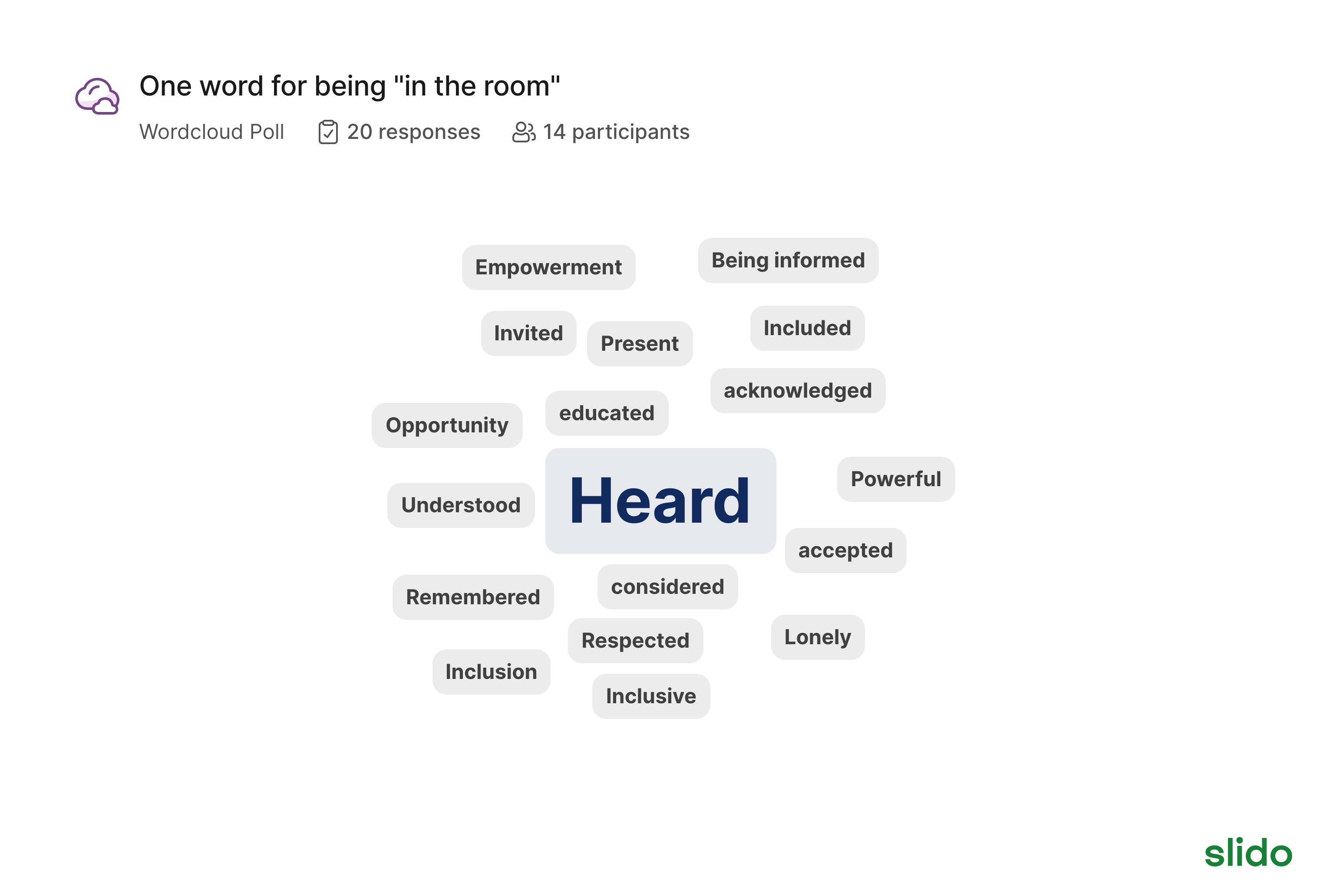
When asked for one word describing what it feels like to be in the room for decisions that affect you, responses spanned a wide emotional range. Tucked among these was also the word lonely, a quiet but important reminder that presence and belonging are not always the same thing.
Midway through the panel, we asked participants what they were sitting with in that moment:
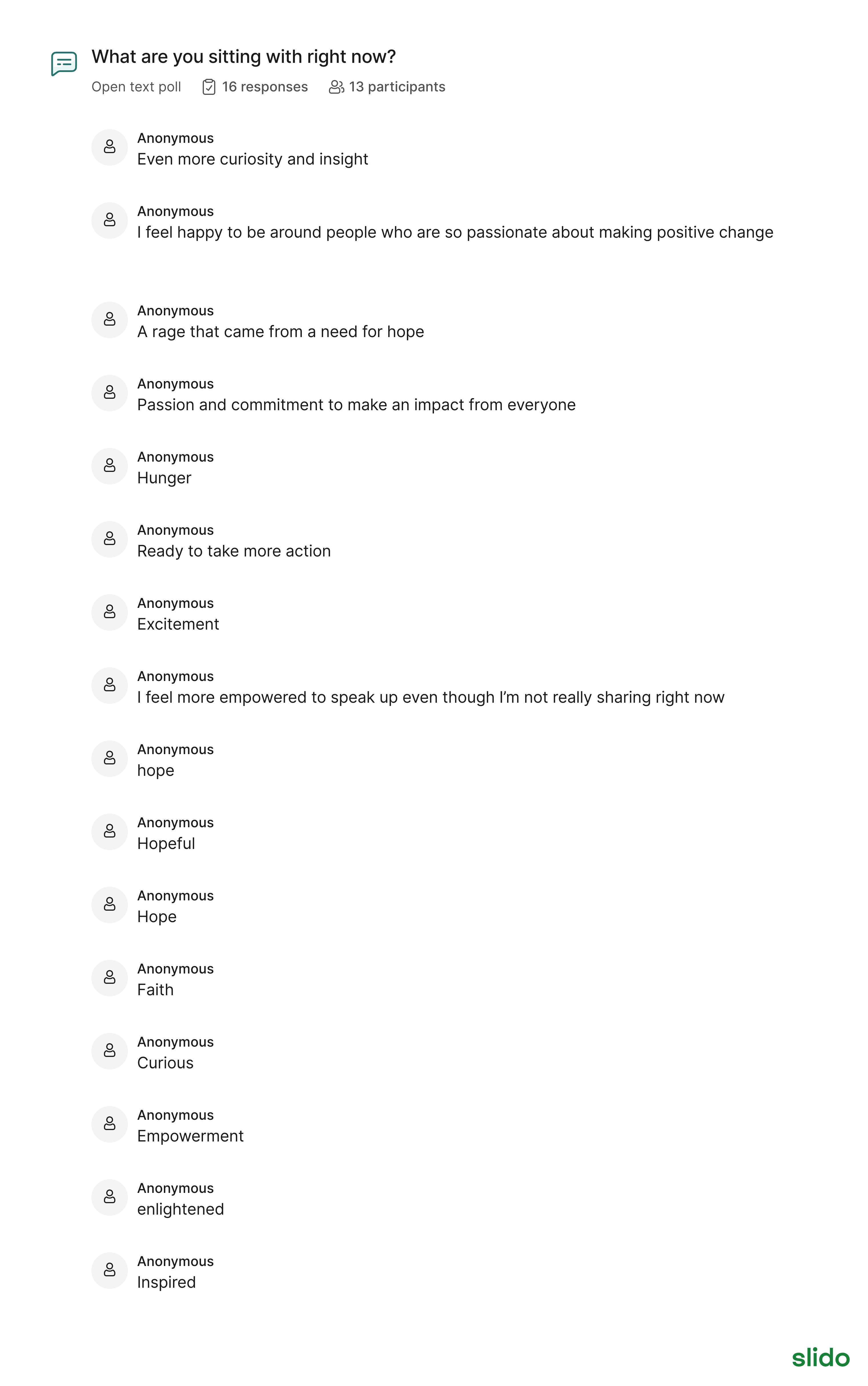
Several folks described feeling more empowered to speak up, even without sharing aloud in the moment. Others named the complexity of what they were holding more directly, describing a rage born out of a need for hope, alongside passion, commitment, faith and a sense of being genuinely inspired by the people around them.
What We’re Carrying Forward
If there was a single thread tying the evening together, it’s this..
…a seat in the room is never simply given by a system and belonging isn’t guaranteed the moment you arrive.
Both have to be built, conversation by conversation, chair by chair.
Our cohort closed the night reflecting on what they’d carry forward and what action they might take next, creating space to turn tonight’s honesty into something lasting.
Resources
Democracy Conversations Map: https://democracyconversations.com/
Democracy Dictionary: https://assets.nationbuilder.com/apathyisboring/pages/1286/attachments/original/1725557522/AisB_-_dico_de%CC%81mocratique_vEN.pdf?1725557522
Democracy Deck: https://prezi.com/view/qBEHOKj7vVi2jRCRUvbl/?referral_token=cZNsf0lnB3FN
Engaged Edmonton: https://engaged.edmonton.ca
How Our Government Works: https://assets.nationbuilder.com/apathyisboring/pages/1286/attachments/original/1725644890/AisB_-_How_our_government_works_vEN_%281%29.pdf?1725644890
Meet Our Panelists
Echo Keizer — Co-Chair, PAVA
Echo is a mixed-Inuk transmasculine person currently residing in amiskwacîwâskahikan, now known as Edmonton, and a graduate student in Public Health at the University of Alberta studying the wellbeing impacts of Bill 9 on Alberta’s Trans, Nonbinary, and gender-expansive community. Echo Co-Chairs the People’s Advocacy Voice of amiskwaciwâskahikan (PAVA), an organization advocating for gender equity for women and gender-diverse people in municipal governance, and is also active in the local Queer and Trans community.
Cherie Tellier-Klassen — Co-Chair, PAVA
Cherie is a leader known for her results-oriented approach to stakeholder relations and advocacy, with 24 years of experience spanning small business and nonprofit organizations. Over her career, she has secured major government funding, driven public policy change, built coalitions, and led innovative efforts for economic recovery during challenging times. She is also recognized for her commitment to advancing equity, diversity, and inclusion, as well as women’s empowerment and leadership across sectors, and has earned the Queen Elizabeth II’s Platinum Jubilee Medal for her impact in Alberta.
Sarah Alemu — Edmonton RISE Program Coordinator, Apathy is Boring
Sarah serves as the Edmonton RISE Program Coordinator with Apathy is Boring, an organization that has spent the last 20 years connecting, educating, and activating thousands of young people to participate in Canadian democracy. Apathy is Boring’s mission is to ensure every young person in Canada is civically and democratically engaged, whether through formal participation like voting, community organizing around issues they care about, or advocacy at the institutional level. Sarah is passionate about helping young people feel confident creating the change they want to see right here in Edmonton, facilitating community connections, learning, and conversations to understand how youth engage with democracy today. This lab was proudly hosted in partnership with Apathy is Boring’s Table Topics in Your Neighbourhood initiative, which trains young people across the country to host their own civic conversations with friends and family.
Tiffany Efird — Project Lead, Youth & Community Education, John Humphrey Centre for Peace and Human Rights (JHC)
Tiffany leads youth-centered and community educational programming at JHC, a non-profit education charity founded in 1999 that works to advance dignity, freedom, justice, and security through collaborative relationships and transformative education rooted in human rights and peacebuilding. JHC has worked nationally to address systemic inequalities, empower marginalized communities, and foster inclusive, rights-based solutions to complex social challenges. Tiffany’s programming focuses on areas including 2STQLGBIA+ inclusion, digital safety, and addressing gender-based violence.
Stella Igweamaka — Creator, For the Love of My City – YEG | Edmonton
Stella is a researcher, storyteller, and community engagement professional based in Edmonton, working at the intersection of public engagement, research, and strategy to help organizations better understand the communities they serve. She created For the Love of My City – YEG, a platform that encourages Edmontonians to discover their city, connect with their communities, and actively participate in shaping Edmonton’s future, with a particular focus on helping newcomers and women feel a stronger sense of belonging and confidence in civic life.
Joyce Cai — President, Youth Leaders in Law (YLL) Edmonton
Joyce is a high school student based in Edmonton and President of Youth Leaders in Law, a youth-led and youth-oriented non-profit active in Edmonton and across Canada. YLL’s mission is to encourage students from diverse backgrounds to pursue their interests in the humanities, particularly law, working to make legal knowledge and pathways into the profession more accessible before post-secondary education and to reduce the stigma around accessing justice. Joyce believes young people are the driving force of society and is passionate about supporting her peers in becoming more community-oriented and civically engaged.
Mirelle Djajasaputra — Young Politicians of Canada, Alberta Chapter
Mirelle serves as Co-Chair of YPC Alberta, the provincial arm of the Young Politicians of Canada, a national, non-partisan, non-profit organization dedicated to empowering the next generation of Canadian leaders. YPC delivers leadership programs, policy councils, task forces, and government placements, connecting emerging leaders with national and international governance networks to foster informed, engaged, and impactful citizenship.
Thank you to our panelists for the depth they brought to this conversation, and to everyone who showed up ready to name what’s true about the rooms we move through <3
Next up: Health Equity & Social Determinants of Health, Aug 7.