

On July 10th, fifteen of us gathered, in the Inspiration Room at EPL Stanley A. Milner and on screens, for the first Civic Exploration Lab of ECHOFORM‘s 2026 Artivism Cohort: Belonging & Justice.
The timing wasn’t accidental.
The lab landed in the week of World Population Day, which asks the world to think about the people behind population numbers. We sharpened that question for our own purposes: World Population Day asks who is counted. Belonging & Justice asks who is cared for, heard, housed, fed and able to participate.
We opened the way ECHOFORM opens everything: by grounding in land, and then by asking a deceptively simple question.
What does home mean to you?
The room’s answers, gathered anonymously, set the tone for the whole evening. Home is safety. Home is chosen family. Home is community, “a village of loving people.” Home is a decompression space. Home is Mother Earth. Across every response, the same threads: safety, belonging, comfort, a place where I can be my true self. Nobody said an address.
The story circle
Our panel wasn't a panel in the usual sense. It was a story circle: four community voices whose work lives exactly where belonging and justice collide:
Nancy Tangon, co-founder of Canada Confesses, brought a perspective grounded in psychology, digital safety, youth leadership, and community engagement. Through Canada Confesses, a youth-led nonprofit that has reached more than 70,000 people, she works to amplify marginalized voices through anonymous storytelling and challenge the myth that Canada is free from racism and systemic inequities.
Kieran Ramnarine (he/him/any) of Mutual Aid Munchies connected his work as an educator and researcher with more than a decade of grassroots organizing. A computer scientist and experiential learning coordinator at the University of Alberta, he explores the intersection of technology and social justice while helping lead a mutual aid collective that supports unhoused neighbours through food, relationship-building, and collective care.
Camille, a volunteer with Food Not Bombs Edmonton since 2022, spoke from hands-on experience organizing community meals, coordinating food and clothing donations, and advocating alongside unhoused Edmontonians and other marginalized communities. Food Not Bombs Edmonton is a non-hierarchical volunteer network rooted in veganism, pacifism, and anti-capitalism that advances food security through free meal programs and mutual aid.
Yusi Mohammed of Righting Relations brought the perspective of a Somali multidisciplinary creative who believes stories have the power to heal, connect, and transform. Through poetry, spoken word, and community facilitation, she explores identity, humanity, and the wisdom of lived experience. Righting Relations supports adult educators and community organizers with the space, relationships, and resources needed to organize for social change.
When we asked who is missing from conversations about community wellbeing, the panel’s answers converged from very different directions. We heard about why marginalized people hesitate to speak at all: fear of the aftermath of speaking up, and why online communities can feel safer than physical ones, a reminder that the assumption of Canada as a universally safe place doesn’t match everyone’s experience. We heard how economic systems shape which resources are accessible to whom, alongside an uncomfortable inventory each of us was asked to sit with: how might our own workplaces, friendships, educations and communities quietly perpetuate the same barriers?
And we heard the panel dismantle, plainly and patiently, some of the most persistent public myths about homelessness: that it is a choice, that it implies criminality, that addiction defines it. One question posed to the room reordered assumptions entirely: which came first, the homelessness or the addiction? Behind every statistic, the panel reminded us, is simply a person, one who deserves water, eye contact, and to be treated as human.
On belonging
What makes true belonging possible? A safe place where people can be themselves, in the way they want to be, not defined by what colonial expectations say that should look like. Belonging as a practice scaled to whatever you have: resources if you have them, and if you don’t, eye contact, a smile, a conversation. And belonging as something environmental, the panel reflected on how spaces like volunteering can bring someone closer to the person they want to become, especially for newcomers navigating exclusion.
On harm, and on rest
On how harm shows up in systems, we heard that providing access to opportunity, treating people as capable rather than forcing them into roles based on circumstance, is itself a form of justice. We also heard honest disillusionment: that justice as an institution serves some and fails others, and that skepticism of it is earned.
And the panel named something this field almost never says out loud: burnout affects everyone in community work, and we don’t talk enough about rest. Learn to rest, the room was told. Build compassion intentionally. There will always be work tomorrow.
On storytelling
This being ECHOFORM, we asked what storytelling can actually shift. One answer belongs on our wall: lived experience is storytelling, and should be treated as a form of data. We heard how a single chance conversation can turn a stranger into an ally and a contributor. And we heard the ethics that must travel with every story: the way you tell a story matters. Use the vocabulary of the person whose story it is. Always ask consent before carrying someone’s story further.
That last principle shapes this very post, which is why you’re reading themes and ideas here rather than the personal stories generously shared in the room. Some things belong to the circle that held them.
What the room was sitting with
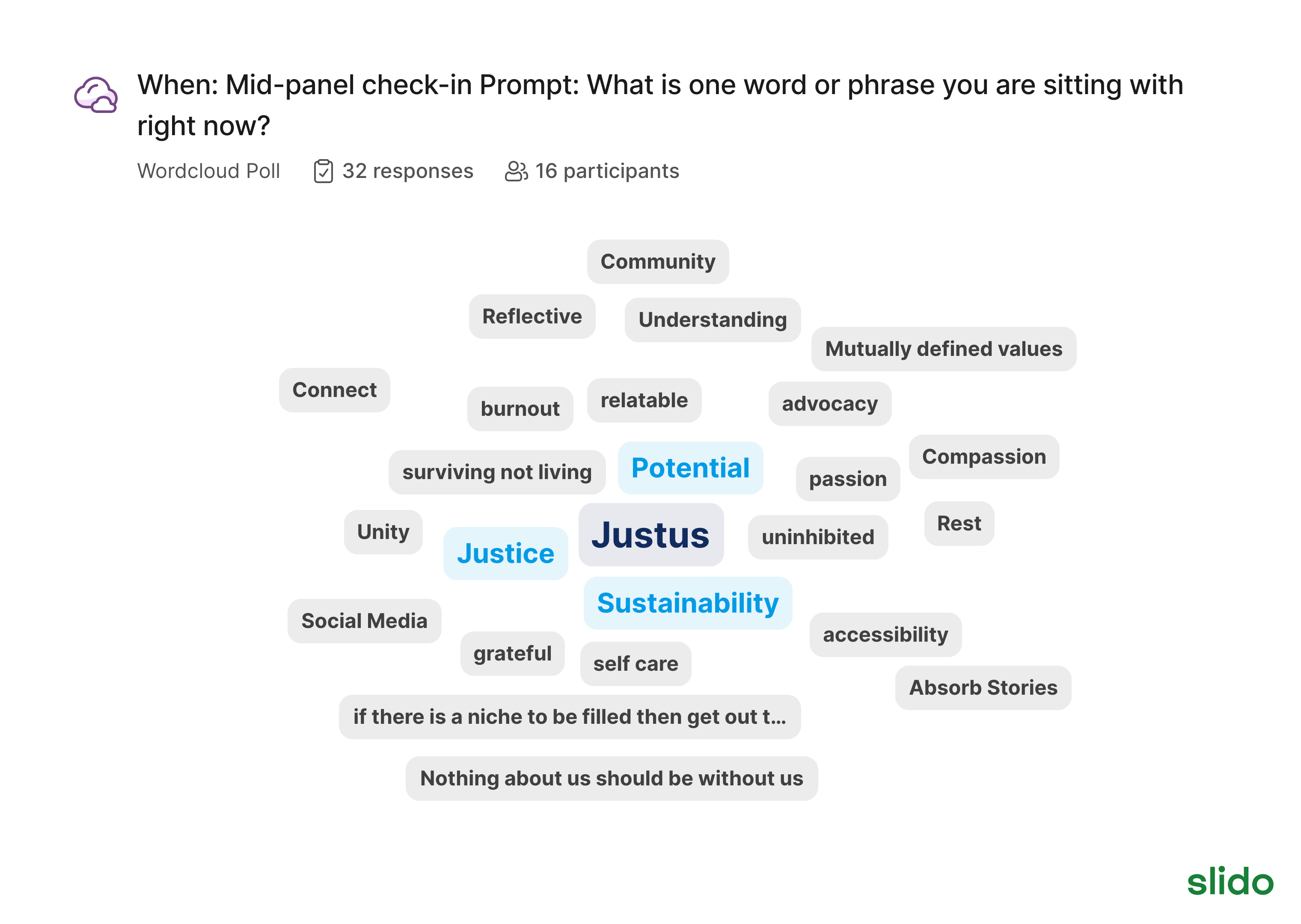
Mid-panel, we asked everyone, in the room and online, what word or phrase they were sitting with. Thirty-two responses came back: Surviving not living. Nothing about us should be without us. Rest. Burnout. Advocacy. Accessibility. Absorb stories. Compassion. Community.
A word cloud as honest as any evaluation we could design.
From what we heard to what we carry
Then, as always, we made things. Participants chose their creative paths and began the first responses that will grow into the Civic Zine, the October showcase, and beyond.
The panel’s parting advice for young people was strikingly consistent: young people are already more open-minded, better informed, and more invested in building a better world than they’re given credit for. You have power, start small and local. Don’t get stuck picking at the holes in the system; you’ll always find them. Focus on what you can do. Find a group, volunteer for a single day, see what it’s like. Absorb as many stories as you can. And learn to rest as deliberately as you schedule everything else.
Six labs to go. But the frame is set, and it came from the room itself: belonging is not just being invited in. Justice is helping shape the conditions that make belonging possible.
With enormous thanks to our four panelists, Nancy Tangon (Canada Confesses), Kieran Ramnarine (Mutual Aid Munchies), Camille (Food Not Bombs Edmonton), and Yusi Mohammed (Righting Relations), and to our volunteers who made the evening run.
Next up: Climate Futures, July 17.