

Every generation has had to learn how to read the media around it. While balancing that, ours has also had to grapple with learning how to read systems that are reading us back, systems that quietly decide what we see, what we believe, and who gets hurt in the process.
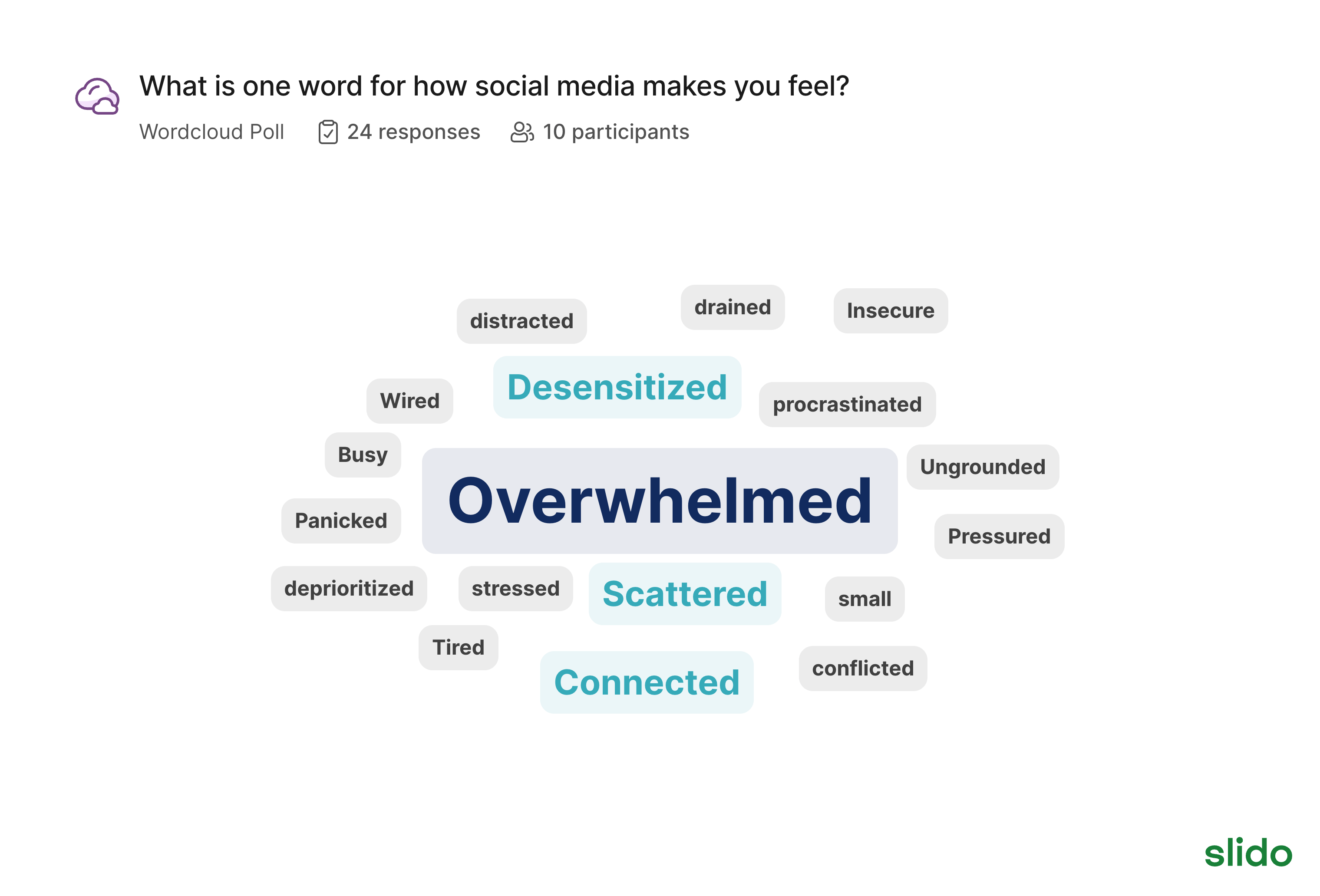
That tension sat at the center of Lab 03 of the 2026 Artivism Cohort, held virtually and projected live for our in-person cohort participants at Edmonton Public Library’s Stanley A. Milner branch. Seven panelists, spanning journalism, academic research, survivor advocacy, political commentary, and grassroots content creation, joined us for a story circle conversation about media literacy and digital culture.
What emerged over the course of the evening was less a tidy set of talking points and more a shared reckoning with how deeply algorithms and platforms shape our information lives, and how unevenly the harm of those systems gets distributed.
Then, we opened the way we always do, with a simple question that turned out to have no simple answer: what does media literacy actually mean to you?
Media Literacy Isn’t One Thing
Erika Barootes described media literacy as fundamentally relational, something closer to a two way conversation than a one way stream of content to be passively absorbed. In her view, effective communication starts with understanding that no single message will resonate with everyone, and that narrowing in on a specific audience is what actually creates room for authenticity and transparency. She pointed to formats like casual get ready with me style videos as evidence that media, at its best, functions as an interactive tool for reaching people who might otherwise never engage with a message at all.
Nicolette Little, PhD, pushed the definition further. In her teaching at the University of Alberta, media literacy typically starts with identifying misinformation and disinformation within what she described as a post truth information environment. But she was clear that the definition can’t stop there. It also has to reckon with the histories and downstream consequences of emerging technologies themselves, including the significant environmental costs associated with AI systems, and the way algorithmic systems can produce outsized, sometimes severe harm for people based on race, gender, and other aspects of identity. For her, true media literacy means having a fuller understanding of how media systems work well enough to know when and how to place limits on them.
Isabella Wen offered a personal history that reframed the whole discussion, describing formative early experiences with a tightly controlled media environment that limited which stories were accessible to the public. That experience shaped her belief that the stories we’re exposed to directly determine who we come to empathize with, which problems feel urgent to us, and which futures we can even imagine as possible. After settling in Canada, she described falling in love with social media because of its capacity to build community and connect people to activists, artists, and leaders around the world. At the same time, she was direct about the underside of these same systems, noting that algorithms capable of building movements are equally capable of deepening polarization and spreading hatred faster than almost anything else. For her, media literacy is ultimately about figuring out how to protect media’s power to connect people across cultural lines while pushing for systems that are not designed to profit from division.
Gabrielle Barber traced her understanding of media literacy back to a very concrete moment: the confusion she saw building around an upcoming Alberta referendum, which prompted her to begin producing her own political explainer content a few months prior. She was candid about growing up almost entirely online and about the value of having been encouraged to consume political media critically from an early age, a foundation they felt obligated to pass on by making complicated political information more accessible to her peers. For Gabrielle, media literacy today goes well beyond parsing the accuracy of a single post or video essay. Because so much of political life now unfolds on social platforms, she framed media literacy as fundamentally about understanding how online content shapes real world opinions and actions, particularly for the large number of young people and older adults alike who rely almost entirely on social media for their political information.
Natasha Dixon brought the conversation into her work at the Digital Sexual Violence Support Centre, where media literacy is treated as a practical toolkit for adults to interpret the messages embedded in the content they consume, particularly around romance and sexual health. She noted that many people absorb their understanding of these topics through social media, television, radio, and music, often without recognizing the subtler forms of harmful messaging layered into that content. Some of it is easy to spot, like overtly misogynistic rhetoric associated with red pill ideology. Other forms are far more difficult to identify, such as individuals using the language of therapy or emotional support to manipulate or coerce. In her organization’s framing, media literacy is about equipping people to notice these subtler tactics and to distinguish genuine, reliable guidance from content creators offering advice without any real safety net behind it.
Karen Unland zoomed out to look at the incentives driving both the people creating content and the platforms hosting it. She encouraged the group to always ask whether a given piece of media is genuinely trying to build understanding, trying to persuade, trying to capture attention in order to sell something, or trying to provoke anger in service of a political goal. She was quick to point out that this tension between informing and manipulating audiences isn’t new. It has existed across newspapers, radio, and television long before the current platform era, even if the scale and speed have changed dramatically. She also spoke about the value of cross generational learning, noting how conversations across age groups within her own life help keep her current on shifting vocabulary and cultural context.
Noor Azrieh closed the round by framing media literacy as an active skill that has to be practiced continuously rather than something absorbed passively over time. She argued that this practice matters more than ever in Canada given how much mainstream news has receded from social platforms, leaving a media landscape increasingly populated by independent creators and small teams working with limited resources. For her, being media literate means understanding the current information environment well enough to recognize just how difficult it has become to access straightforward, reliable facts, down to noticing when a news article leaves a source unnamed or fails to disclose an underlying conflict of interest.
Naming the Harm
The emotional and analytical center of the evening arrived when the conversation turned to algorithmic and platform violence, and to who bears the brunt of it.
Natasha did not soften the scale of the problem, and rightfully so. She described how the sexual exploitation of women and girls has effectively been commercialized into a career path within corners of the internet known as the manosphere, where creators run so called wealth academies that instruct young men and boys in how to manipulate, lure, and financially profit from women online. She cited data from the Canadian Centre for Child Protection indicating that roughly eighty four percent of targets of online extreme sexual violence are girls, alongside Statistics Canada findings that one in three women and girls report experiencing unwanted online sexual behaviour. She connected the pandemic era, along with the rapid rise of generative AI tools, to a further normalization and escalation of these harms, and argued that social media platforms actively enable this violence by fostering insular echo chambers, while provincial and federal legal frameworks still lack sufficient enforcement power to meaningfully deter perpetrators. The result, she said, is that women, girls, and gender diverse people continue to bear a disproportionate share of this harm.
Nicolette introduced a distinction that reshaped how the room understood the issue. She separated technology facilitated violence, in which a person actively uses digital tools to harass or harm someone, from algorithmic or platform violence, in which harm is produced automatically by a system’s design, without any single human perpetrator directly responsible in the moment. Her clearest example involved automated memory features built into many platforms, which resurface old photos without warning. For survivors of gender based violence, this kind of feature can unexpectedly bring back images connected to a past abuser. She traced this pattern back to who typically builds these platforms in the first place, a workforce that remains largely homogenous, predominantly white, privileged, and cisgender, and therefore often lacking the lived experience necessary to anticipate how a given design choice might end up harming marginalized users, women, and survivors specifically.
Erika reflected on this dynamic through the lens of parenting teenagers in the current media environment, describing the difficult position many parents find themselves in. Keeping kids off social platforms entirely may protect them from certain harms, but it can also isolate them socially and expose them to exclusion or bullying for simply not being present online. She described how engagement driven algorithms tend to reward the loudest and most well funded voices, creating what she called validation circles and echo chambers that normalize groupthink, the spread of deepfakes, and more subtle, passive forms of gender based harm. Because of this, she argued strongly that media literacy needs to become a consistent part of every classroom, teaching young people to stay curious, avoid relying on a single source, and actively cross check information before accepting it.
Gabrielle offered an example from her own content creation work, describing how posting an educational video about Alberta politics led to an inappropriate and objectifying message within hours of the post going live. They pointed out that a male peer posting the exact same political content would be extremely unlikely to face that kind of response, using her own experience to illustrate how online platforms routinely force women to navigate unwanted sexualization and harassment simply for participating in public discourse.
Noor turned attention toward institutional accountability, noting that government bodies are already fully aware of the scale of platform related violence, pointing specifically to acknowledgments from Canada’s Privacy Commissioner regarding the sheer volume of sexualized deepfake images being generated every hour. She was critical of how slowly government has moved to respond, arguing that years of delayed action have allowed the problem to compound into a far larger crisis than it needed to become, and called for greater public pressure on elected officials to address root causes rather than allowing harm to continue unchecked.
Isabella connected the abstract framing of algorithmic harm to a very personal turning point, describing how the term initially felt distant to her until she began receiving hateful comments on a feminist podcast project she had worked on. That experience shifted her understanding of online hostility away from a simple story about individual bad actors and toward a recognition that platform algorithms are often deliberately designed to reward and amplify divisive, hateful content because that content performs well. She spoke strongly in favour of building media literacy directly into K through 12 curricula, reflecting on how young people are exposed to intense online pressures without any structured guidance or open conversation at school to help them process it.
Inside the Manosphere
We asked panelists to move past the abstraction of the term manosphere and describe, as concretely as possible, what that space actually looks like from the inside for the young men and boys who end up inside it.
Nicolette, drawing on her professional background advising on cases of gender motivated violence, described the manosphere as a rapidly growing ecosystem, particularly concentrated among men between eighteen and thirty five in countries including Canada, the United States, Australia, and the United Kingdom. She connected its growth to traditional gender socialization patterns that teach boys to be stoic and aggressive while teaching girls to be polite and deferential, a dynamic she argued creates an unhealthy cycle that feeds directly into gender based violence. She outlined four distinct currents within this broader ecosystem. Men’s Rights Activists tend to misuse statistics to argue that men are now the subjugated group in society. Pick up artists teach men to pursue women aggressively while disregarding any resistance or stated boundaries. Men Going Their Own Way advocate for fully withdrawing from relationships with women altogether. Involuntary celibates focus their frustration on an inability to find sexual partners, often romanticizing past eras in which women had far less social and personal autonomy. She singled out YouTube’s recommendation algorithm as one of the most powerful engines driving radicalization within this space, capable of pulling a user toward increasingly extreme content after only a small handful of searches. While she acknowledged that this broader online ecosystem is nuanced and includes some genuinely supportive spaces for men, she was clear that the volume of violent and radicalizing rhetoric circulating within it makes the overall picture deeply concerning.
Isabella pointed to a recent television series as the clearest cultural depiction she’d encountered of how a young person moves into this kind of ideological space. She emphasized that extremism rarely announces itself as extremism from the outset. It typically begins with ordinary loneliness and a lack of positive mentorship, conditions that manosphere content is specifically positioned to fill. She described one proposed counterweight she’d heard, centered on book clubs featuring fiction with emotionally open, empathetic male protagonists, offering young men alternative models of masculinity that push back against harmful hyper masculine posturing common in this space. She closed by stressing that effectively countering these harmful narratives requires positive role models, uplifting media representation, and solutions developed directly alongside men and boys rather than imposed on them from outside.
Karen approached the topic through the lens of parenting, reflecting on the factors she believes help shape a young person’s rejection of manosphere ideology. Growing up in a household that models non traditional gender roles can offer an early, lived example that challenges conventional expectations. Supportive friendships built around shared values, along with close and respectful relationships with women and girls in one’s own family, can further reinforce healthy attitudes. She also highlighted the value of an intentional approach to technology itself, describing the importance of a person actively choosing what content to seek out rather than passively accepting whatever a recommendation algorithm surfaces. Seeking out specific channels directly or connecting with friends through smaller, more curated online spaces, she noted, can help someone largely avoid algorithmic rabbit holes and retain a stronger sense of agency over their own online experience.
Noor argued that the manosphere should not be understood as some hidden, isolated corner of the internet, but rather as a pervasive force woven into everyday digital life. She connected young men’s vulnerability to this content to broader conditions of hopelessness, job instability, and economic anxiety facing a generation that, by many measures, is likely to be worse off financially than their parents. She was careful to note that these conditions do not excuse misogynistic behaviour, while still emphasizing that this sense of aimlessness makes young men considerably more susceptible to extremist recruitment. She also raised a difficult question about media accountability, pointing to the frequency with which mainstream outlets produce documentaries and features profiling extremist creators, and asking whether that kind of coverage genuinely serves the public or simply re-litigates harmful ideologies and grants them further attention and legitimacy.
Natasha closed this portion of the conversation by describing what a survivor centered, trauma informed approach to digital harm actually looks like in practice, and where mainstream platforms and policy continue to fall short. In practice, this approach centers on listening closely, validating a survivor’s experience, and meeting people exactly where they are without judgment. Unlike rigid clinical or police led processes that push survivors through fixed procedural checklists, this model supports people regardless of whatever coping strategies they’re using to get through a given day, and offers multiple flexible paths toward healing and justice, whether that means engaging with the criminal legal system, exploring transformative justice approaches, or simply having access to a safe space to process what happened. On the policy side, she pointed to Canadian legislative processes tied to Bills C 63 and C 27, arguing that public consultation on these bills has frequently been inaccessible to everyday people, particularly those working multiple jobs just to manage the cost of living. She also noted a broader pattern among tech companies and venture capital investors, who tend to gravitate toward profitable, surface level products such as tracking or mood monitoring apps that treat symptoms rather than addressing the underlying structures that enable violence and exploitation in the first place. In her view, platforms consistently prioritize profitability over meaningfully connecting survivors with immediate, practical support.
Gabrielle added a final layer to this thread, describing how involvement in the manosphere often begins through something as seemingly harmless as ironic humour, which can gradually erode empathy, normalize misogynistic attitudes, and nudge young men toward more extreme political positions over time. Shifting to her own work producing political explainer videos, she described the ongoing challenge of balancing thorough research against video length and viewer retention. She emphasized that staying strictly non partisan, neutral, and fact focused has been essential to building trust with her audience, since that approach allows her content to reach conservative leaning viewers who might otherwise dismiss anything perceived as politically biased.
What We’re Carrying Forward
After the panel, we surveyed participants again, asking “what is one word or phrase you are sitting with right now?”
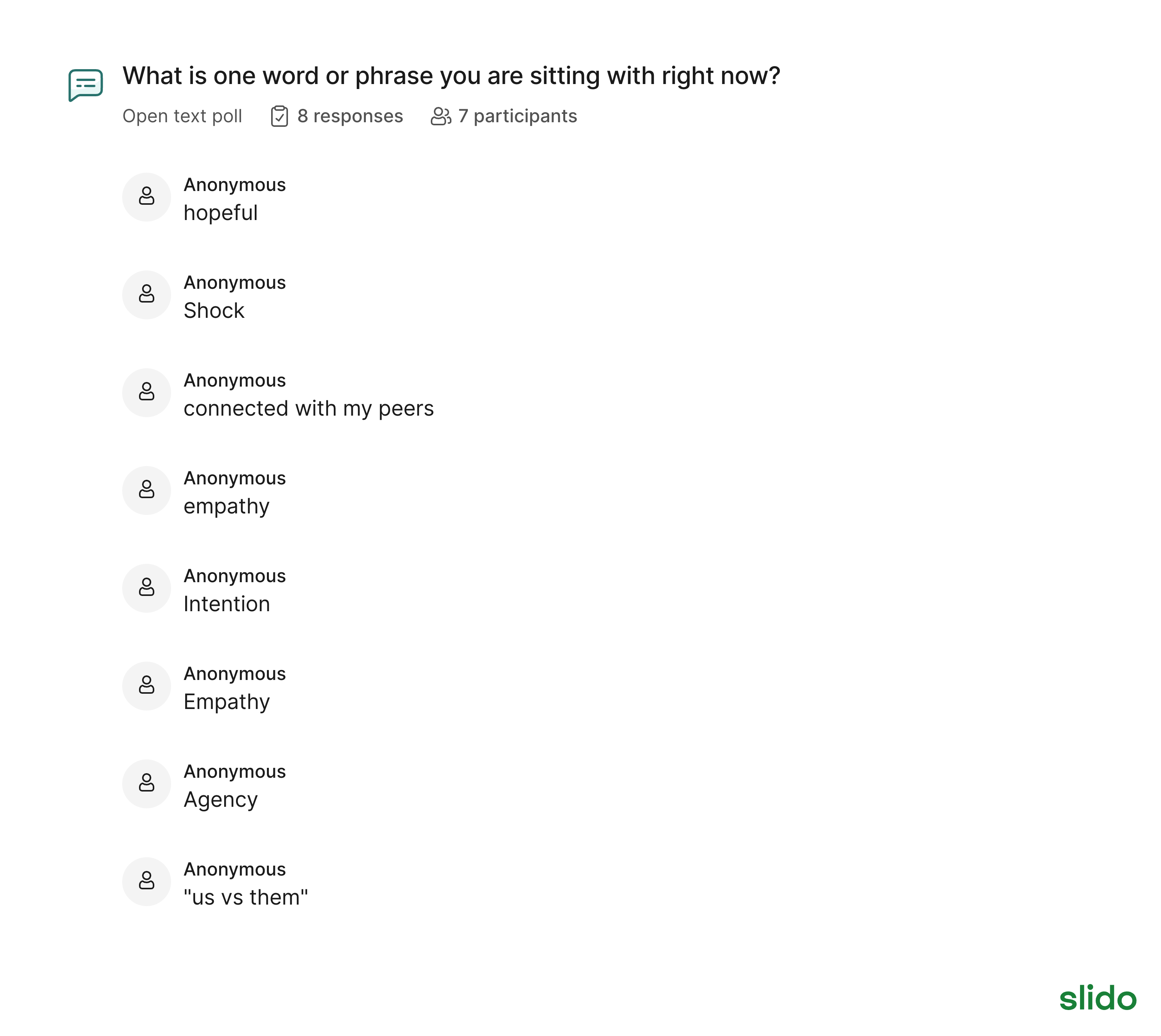
If there was a single thread tying all seven voices together across the evening, it’s this. Platforms are not neutral. They are built by people, shaped by specific incentives, and those incentives determine who ends up protected and who ends up targeted. Throughout the conversation, media literacy was never framed as a personal failing that individuals simply need to overcome on their own. It was framed instead as a form of civic knowledge, something that has to be deliberately taught, consistently practiced, and actively demanded of the systems producing and distributing our information in the first place.
Media doesn’t just report the world. It decides who gets seen in it. Literacy is how we take that power back.
Our cohort closed the evening the way we always do, by creating something directly from what we heard.
Thank you to our panelists, Isabella Wen, Karen Unland, Erika Barootes, Nicolette Little, Natasha Dixon, Gabrielle Barber, and Noor Azrieh, for the honesty and expertise they brought to this conversation.
Meet Our Panelists
Isabella Wen — a young storyteller who believes in hope as a radical act of resistance. Isabella founded a public speaking workshop series that’s reached over 300 youth, co-founded a feminist media organization, and leads a global public health communications team at UBC. She currently serves as Canada’s representative to the TikTok Global Youth Council.
Karen Unland — Co-Founder of Taproot Publishing and Editor-in-Chief of Taproot Edmonton, which delivers reliable, original local journalism, newsletters and podcasts for the Edmonton region. Before Taproot, Karen worked at the Edmonton Journal and started the Alberta Podcast Network.
Erika Barootes — a Canadian public affairs professional, commentator and podcaster who has worked with premiers, served as founding president of a provincial political party, and now advises companies on brand, reputation and advocacy. She’s co-host of The Discourse Podcast and just launched The Erika Barootes Show: How the West Is Run w/Trending Politics CA.
Nicolette Little, PhD — Assistant Professor in the University of Alberta’s Media and Technology Studies program and Women’s and Gender Studies department, and Director of the Feminist Collaboratory and Data Visualization Centre. Her new book, From Red Dresses to Memory Stones, examines multimedia activism and gender-based violence in Canada. She researches algorithmic violence, the manosphere, and digital whisper networks, and has advised the federal government and law enforcement on media, gender and violence.
Natasha Dixon — Founder and Executive Director of the Digital Sexual Violence Support Centre, a BIPOC and survivor-led non-profit supporting adults who’ve experienced technology-facilitated sexual violence through peer support, workshops and policy advocacy. Natasha draws on Black feminist participatory action research and Caribbean and Indigenous oral history traditions in her work.
Gabrielle Barber — heading into their first year of graduate studies in cultural anthropology at the University of Calgary. Gabrielle researches and posts informative videos about Alberta politics on social media, working to make sure Albertans are informed about what’s happening in their province.
Noor Azrieh — a journalist, producer, and award-winning host of Canadaland Politics. She’s produced long-form documentaries and reported on major international investigations, and also co-hosts Canadaland’s media criticism show. Noor is a graduate of Carleton University’s journalism program.
Next up: Civic Engagement & Democracy, July 31.