

Public spaces belong to the people who live, move, and dream within them. The stories placed there shape who feels seen, welcome and represented.
That simple idea sparked Stories in Public Spaces, a national sticker design contest by ECHOFORM and Canada Confesses Advocacy Institute. It drew 40+ entries from across the country and is now part of Global Artivism Month, a worldwide month of creative action.
The Idea Behind the Contest
Stories in Public Spaces was co-created by the ECHOFORM and Canada Confesses Advocacy Institute teams, with Rika helping to shape it from both sides of the table.
Our starting question was simple: who do our shared spaces currently speak to, and who is missing from them? We asked artivists to answer with one of the smallest ways to leave a message somewhere public, a sticker, surfacing voices too often left out, including those from historically marginalized and equity-seeking communities.
Stickers are small, shareable, and affordable. They show up on lamp posts, laptops, and bus stops, and they let one idea travel far beyond the person who made it. That’s what made them the right medium for a conversation about who gets seen.
By the Numbers
40+ entries from artivists across the country
4 judges
3 recognized designs
1 worldwide month of celebration, November 1 to December 10
Who we built it with
Canada Confesses Advocacy Institute is a youth-driven social justice initiative working to unravel the myth that Canada is free from racism and systemic inequities. It gives marginalized and historically oppressed communities a safe, anonymous place to share their experiences.
ECHOFORM brought its community of young artivists and the stage of the Artivism Showcase.
Together, the two teams built the contest to carry youth voice out of meeting rooms and screens and into everyday shared places.
Meet the judges
Four judges, from across ECHOFORM and Canada Confesses and across Canada, reviewed the entries.
Anurika (Rika) Onyenso is a community builder and youth advocate whose work bridges lived experience, creativity, data, and public dialogue to strengthen social justice outcomes. She joined the panel as ECHOFORM’s founder and Events Lead & Board Member with Canada Confesses, and was especially excited to experience work that surfaces voices too often left out of our shared landscapes, and that invites the public to pause, reflect, and see their surroundings differently.
Noor Hussain is a dedicated youth activist based in Fort McMurray, whose advocacy focuses on youth civic engagement, female empowerment, and inclusion and diversity. She plays for the U18 Huskies, serves as a junior coach for the U13AA Huskies, and is a vocal advocate for girls in sports. Her commitment to systemic change includes her appointment to the Jr Game Changers national leadership program, a place in the inaugural cohort of Human Concern International’s Global Humanitarian Youth Fellowship, and her work on the Mayor’s Advisory Council on Youth. As a grassroots fundraiser, she has mobilized her community to raise over $27,000 for cancer research.
Nicholas Ogaru is the Marketing Co-Lead at Canada Confesses, where much of his role involves content creation and creativity. He was thrilled to see the intersection of art and social justice up close, and said every sticker was unique and full of personality.
Zilan Arik is the Outreach Co-Lead at Canada Confesses, where she helps build connections and grow the community. She was excited about the contest because it’s a fun way to bring a community together, get creative, and give everyone a chance to leave their mark.
Meet the Winners
After careful review, the judges selected three designs:
First Place: Marian M., “The Conversation My Community Needs to Have Is About Food Waste”
Marian is a high school student in her senior year in Manitoba. With a passion for both food and art, she combined her interests to create this digital art piece. She noticed that in her area, food waste was taken lightly, so her design shows a plate, with the title disguised as food being thrown away in the garbage. She hopes to pursue nutritional sciences as a career.
Second Place: Jessica Bulangcao, “The Future I Want to Leave Behind Is Debt-Free”
Jessica is a designer driven by a passion for community and a commitment to making design matter. She stands for diversity, inclusion, and queer and neurodivergent representation. She believes design can be a form of human expression and a tool for good, and she’s drawn to work that feels grounded, intentional, and rooted in the communities it serves. See more of her work at jebudesign.ca.
Publicity Award: Beck Irvine, “Nobody Asks Me About T-Boy Hunger But They Should”
Beck is a Calgary-based artist who works in a wide variety of mediums. A graduate of the Alberta University of the Arts with a Bachelor of Fine Arts in Media Arts and a minor in Object Design and Digital Fabrication, Beck draws on first-hand experiences to direct attention to aspects of everyday life that are often unnoticed or overlooked.
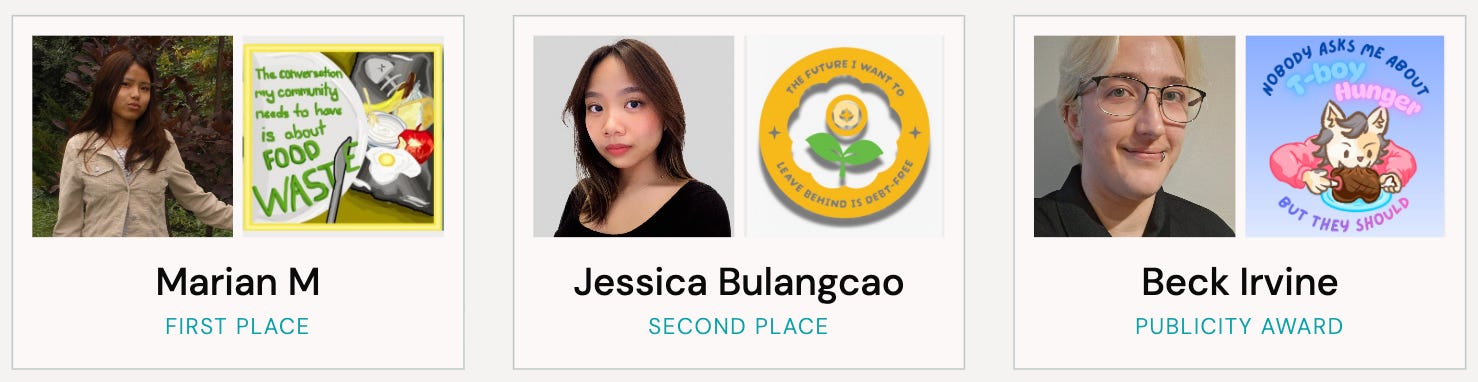
Look at the three titles together: short, honest sentences that start a conversation. That’s exactly what a sticker can do in public.
Every entry mattered
More than 40 artivists across the country answered the call, and every design carried a story. We’re grateful to each person who took the time to share theirs.
On October 17, the designs went up on the wall at Edmonton City Hall alongside their artivist statements. Guests were also invited to write their own true sentence at a live submission station run with Canada Confesses, so the wall of designs grew into a wall of voices.
The stickers have a second home online too. Browse them in our Artivism Anthology.
Part of something bigger: Global Artivism Month
The sticker contest doesn’t end with the showcase. Its designs are now being featured in celebration of Global Artivism Month, and it’s a reminder that a sticker on a lamp post in Edmonton belongs to the same movement as art on walls, stages, and streets around the world.
What is Global Artivism Month?
It’s a globally coordinated cultural mobilization that runs across November 2026 and closes on December 10, Human Rights Day. It was designed to make artivism visible worldwide, and it will be observed every year from now on. It grew out of the Global Artivism gatherings in Pretoria in 2024 and Salvador da Bahia in 2025, and it builds toward the movement’s next global gathering in 2027.
Who can take part?
Everyone: individuals, informal collectives, and organizations of any size. Taking part is free, and existing work counts. If you already have something planned for November, such as an exhibition, a workshop, a launch, or a conversation, you can connect it to the month and be part of the global picture.
The Sunrise Relay
The organizing idea of the month is the Sunrise Relay. Each day, the spotlight travels with the sun: a region opens the day with a short brief on the state of artivism there and the question it wants to raise, hosts a day of local activity, and passes the relay onward at dusk. A daily dispatch and a shared digital space knit the days into one visible global story.
Key dates
November 1: Global Opening Moment, and the Sunrise Relay begins
First week of November: Global Virtual Convening, and the Global Artivism Month Cookbook is published
November 16: Global Day of Action
November 30: Last day of the Sunrise Relay, as the spotlight completes its circuit of the world
December 10: Closing Declaration, a participatory public declaration on Human Rights Day
You don’t have to be active all month. Most participants act on their region’s day, on the Global Day of Action, or on the date their own activity was already planned for.
How ECHOFORM is celebrating
Throughout the month, we’re featuring designs from our Stories in Public Spaces participants on our channels. Follow @echoxform to see them, and share them with someone who might need to see their own story reflected back.
We’d also love to see your own designs, whether it’s a sticker, a poem, a mural, or a conversation you started in your own community. Tag us so we can celebrate it with you.
How you can take part, too
Global Artivism Month offers three ways of taking part, and each one is a door, not a box:
Witness: The lightest way in. Attend a gathering, share a dispatch, join a vigil, or amplify a piece of work. You keep the month visible by sharing, posting, and telling people it’s happening.
Host: Organize something where you are, at whatever scale you can manage: an exhibition, a march, a screening, a mural, a performance, or a conversation, face to face, online, or hybrid.
Create: Put a piece of work into the month, whether it’s poetry, music, a mural, performance, photography, fashion, installation, film, or food. It can be new or existing, finished or still in progress.
There are also two ways of making the month possible: supporting someone else’s work with funding, equipment, space, skills, or connections, and becoming a partner by committing your organization or network in a sustained way.
To learn more, visit globalartivism.org, or write to info@globalartivism.ca.
A note of thanks
To every artivist who entered: thank you for putting your story where the public can see it.
To our judges, Anurika, Noor, Nicholas, and Zilan: thank you for your time and care.
To our winners, Marian, Jessica, and Beck: congratulations, and thank you for starting conversations.
To the Canada Confesses Advocacy Institute team: thank you for building this with us.
To everyone marking Global Artivism Month around the world: thank you for showing that no one makes change alone.
Somewhere near you is a lamp post, a laptop, or a bus stop waiting for a true sentence. Go leave your mark.
Find all our links at linktr.ee/echoxform.
Public space in Edmonton sits on Treaty 6 territory, the homelands of many Indigenous peoples. As we ask who gets seen in the places we share, we stay committed to civic storytelling grounded in truth, accountability, and respect.