

On Friday, August 14th, our cohort gathered to sit with a question that sounds simple until you actually try to answer it: what does it mean to be a citizen of the world, not just a country? Five generous panelists working across education, policy, youth leadership, human rights, and global cooperation joined us to think it through together, alongside young people and community members who showed up ready to listen, question, and create alongside one another.
It was, honestly, one of those nights that reminds you why we do this work in the first place.
Here’s what came out of it <3
Meet the Panelists
Dr. Lynette Shultz is an educator, researcher, and writer whose scholarship connects global citizenship, social and ecological justice, education, and democratic life. Her work explores how education can create space to critically examine systems of power and inequality, including the politics of knowledge and the influence of fossil-fuel interests on climate discourse.
Mariam Karmazanashvili is Project Director of the Sustainable Development Goals Council at the United Nations Association in Canada, where she founded and leads the SDG 5 Fellowship advancing gender equality through policy engagement and youth leadership. She is also the Initiative Coordination Lead with Women in International Security Canada and elected President of the Northwest Edmonton Electoral District Association of the Liberal Party of Canada. Her work bridges public policy, diplomacy, and multilateral dialogue on human rights and sustainable development.
Mambouomuni Kuverua is Curator of the Global Shapers Edmonton Hub, an initiative of the World Economic Forum. A Namibian-born youth leader and financial literacy advocate, he champions cross-sector partnerships that connect communities with industry, government, and nonprofits to build sustainable economic opportunity.
Jannie Edwards is a writer, teacher, and lifelong activist based in Edmonton, currently chairing the Edmonton chapter of Amnesty International. Her decades of community engagement span feminism, anti-war organizing, watershed protection, and Palestine solidarity work, alongside deep roots in Edmonton’s arts and literary communities.
Wajed Nadine El-Halabi is a project manager, facilitator, and researcher with the Alberta Council for Global Cooperation, supporting educational programming and youth initiatives including Alberta’s Top 30 Under 30. Her work centers cultural heritage, gender equality, and community resilience across Canada and the MENA region.
We were also honoured to have Mujahid Ahmed, Regional Manager for Northern Alberta at Islamic Relief Canada, confirmed as a panelist for this lab. Unfortunately he was unable to join us on the night. We hope to welcome him to a future lab.
Where We Started
Before the panel began, we asked the room a simple question to open things up and settle in together: Where in the world do you feel most connected right now?
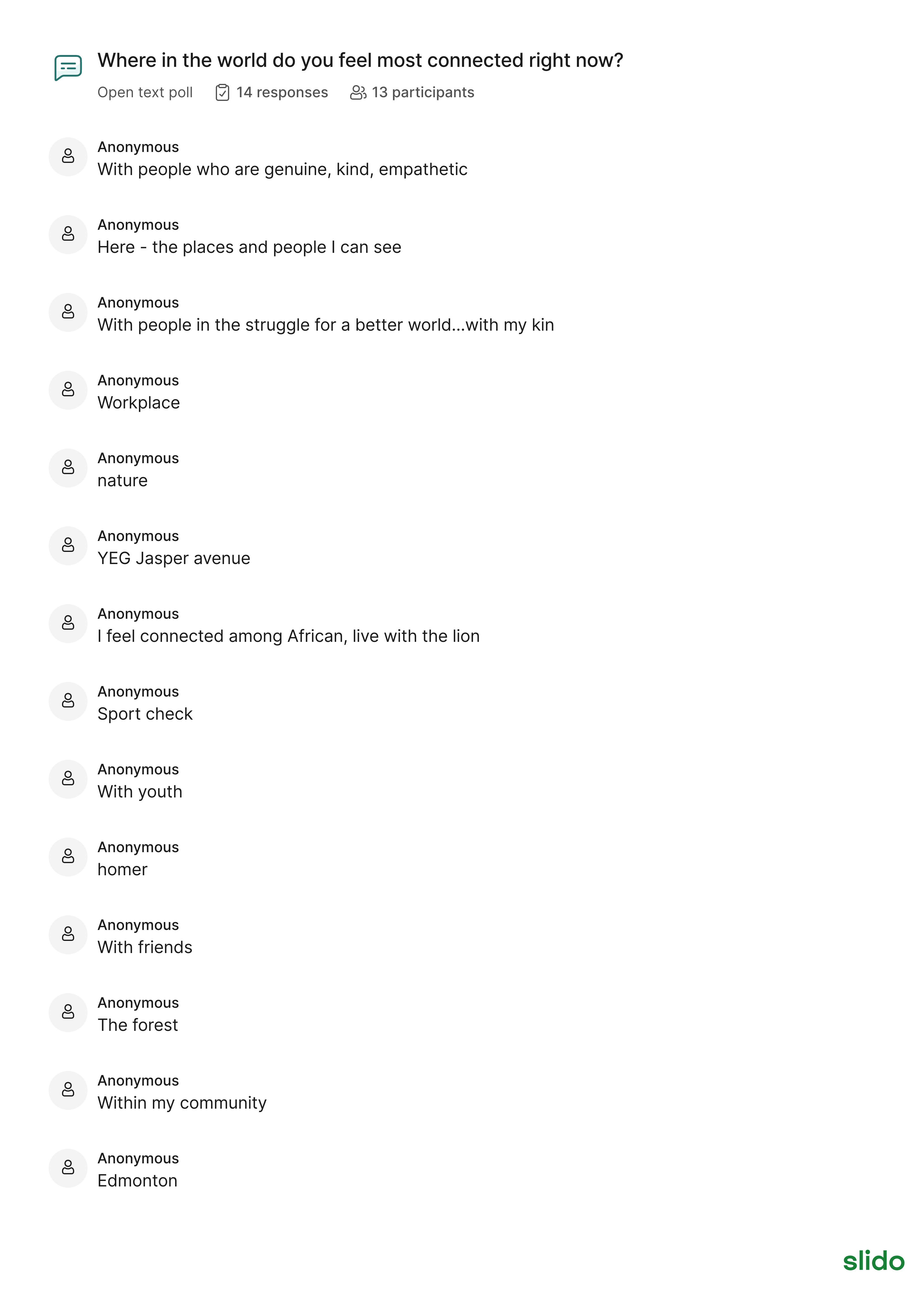
The answers ranged from the deeply personal, to the geographic and even to the political. Reading through them together set such a tender tone for the night, one that moved fluidly between the intimate and the systemic.
Because that’s what global citizenship actually is, when you get down to it.
It’s never just abstract.
It’s where you feel like you belong, and who you feel responsible to.
Connection as the Starting Point
One of our panelists opened with a line that stuck with a lot of us in the room: if the people in a single space became genuinely connected in their commitments and understanding, there’s almost nothing that couldn’t be done. It sounds like a big claim. But the examples that followed backed it up, one after another.
We heard about fog nets in Morocco, an ancient method of harvesting clean drinking water from fog, revitalized using technology developed by Canadian researchers and piloted across Chile and parts of Asia. A technology and a tradition, meeting across borders, to solve something as fundamental as access to water. That’s global solidarity in practice, not theory.
We heard about UNA-Canada’s youth cohort model, where 17 young people take on one of the 17 Sustainable Development Goals each and build a project in their own community, whether that’s climate work in the North or newcomer support toolkits in Ontario. Small, local, specific projects that add up to something much larger.
We heard about Amnesty International’s Write for Rights campaign, and the reminder that sometimes the simple act of a country knowing the world is watching is enough to change an outcome. And alongside that, an honest acknowledgment that we’re living through one of the most difficult periods for human rights in recent memory.
Both things can be true at once, and there was something deeply moving about hearing that held so gently in the room.
That tension, hope and honesty sitting side by side, is worth sitting with.
Reading the World Before We Read the Word
A phrase from the panel that’s going to stay with a lot of us for a long time: we read the world before we can read the word. Before we can act on injustice, we have to be able to name what we’re actually looking at. Is this a system of racism? Is this patriarchy? Is this the colonial matrix showing up again in new packaging? Naming it is the first step toward finding the leverage points where change is actually possible.
We talked about the colonial matrix as something that ranked people’s humanness, connected to patriarchy, imperialism, and racism, and how those systems still shape the economic, social, and environmental problems we’re living through today. The point wasn’t to make anyone feel hopeless about that. It was the opposite: understanding it’s a system, not a battle between individuals, is what makes it possible to resist it collectively instead of getting stuck fighting each other.
Youth as Proof of Concept
Some of the most energizing parts of the conversation weren’t about big institutions at all. They were about what young people are already doing, right here, right now. A group of Edmonton high school students, politically activated after a teachers’ strike, raised money through concerts and art fairs with no starting budget, and built a mutual aid cabinet stocked with hygiene products for peers who were couch surfing. No fanfare. No large infrastructure. Just people noticing a need and meeting it, with whatever they had.
That’s the kind of example that makes “youth-led change” feel less like a slogan and more like a description of something already happening in this city, among people our cohort could easily know.
The Reaction Check
After the panel wrapped, we asked the room a quick gut-check question: What’s one system you interact with every day that you’d want to redesign?
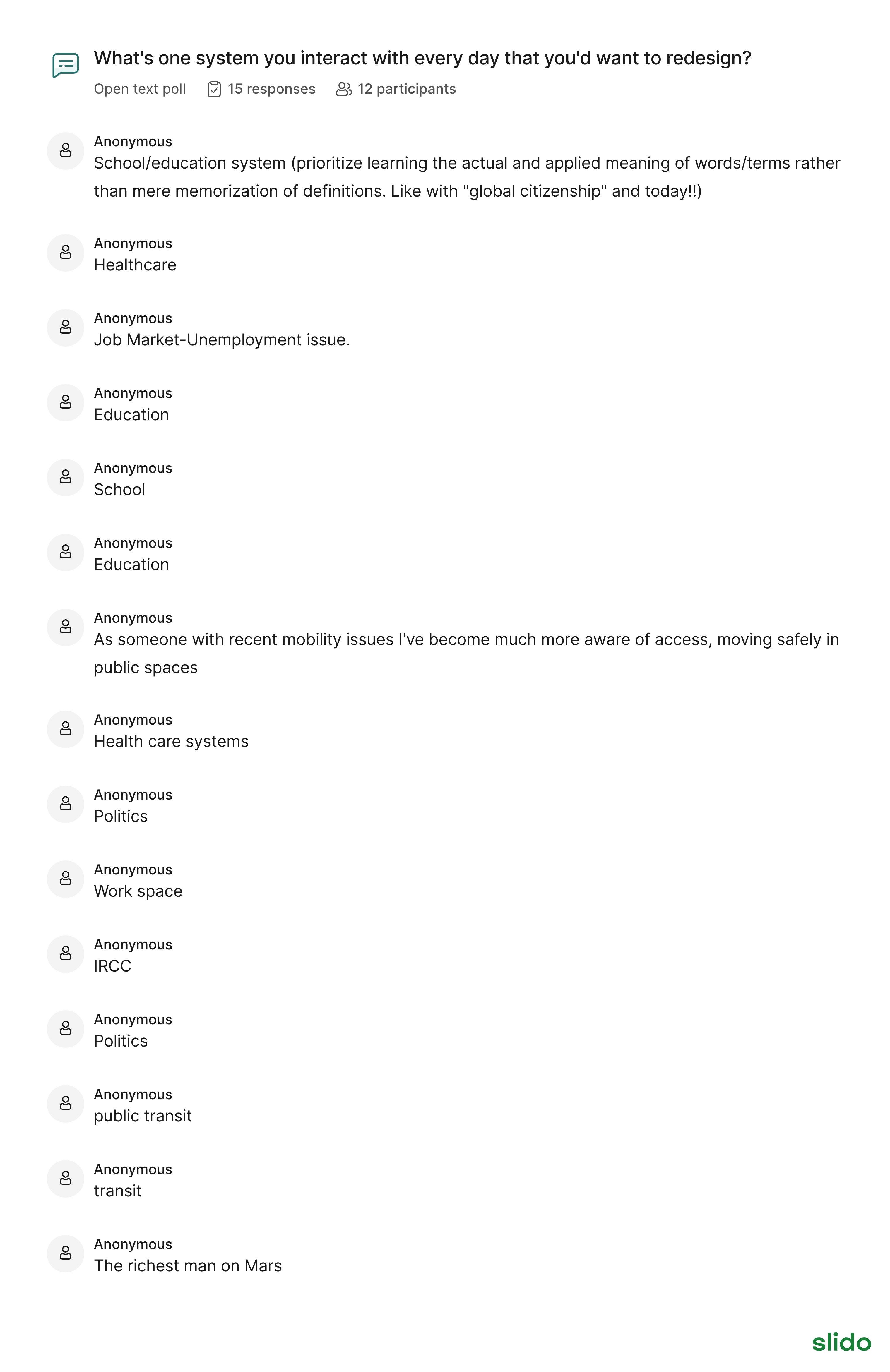
The answers said a lot. Education showed up again and again, specifically the gap between memorizing definitions and actually living them out (one response called this out directly, connecting it back to the very concept of “global citizenship” we’d just spent an hour discussing, which felt like a full-circle moment). Healthcare, public transit, IRCC, and politics all came up too. These aren’t abstract systems for the people in that room. They’re daily friction points, carried quietly by real people.
Closing Thoughts
We closed the night asking one more thing: One takeaway you’re leaving with tonight.
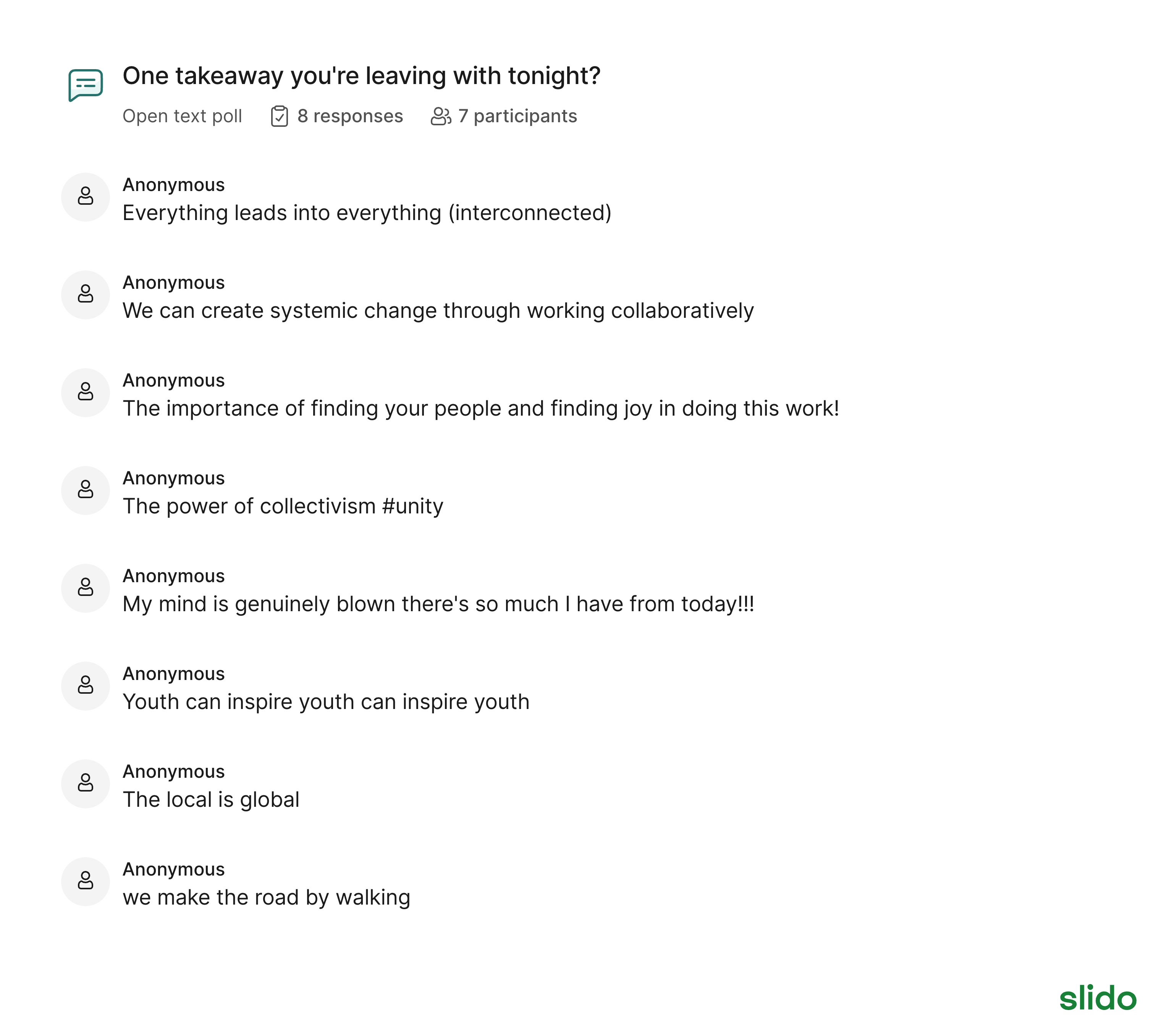
If there’s a thread running through the whole evening, it might be this: power always changes, but accountability stays. Institutions can be flawed and still worth reforming rather than discarding. Change can start with something as small as writing a letter or as large as an international summit, and both matter just as much. The scale of the problems in front of us is real. So is the resilience of the people working on them, especially the young people who keep showing up anyway, again and again.
Thank you, from the bottom of our hearts, to Dr. Lynette Shultz, Mariam Karmazanashvili, Mambouomuni Kuverua, Jannie Edwards, and Wajed Nadine El-Halabi for the honesty and generosity they brought to this conversation. And thank you to everyone in the room who stayed present with it, art materials in hand, for two and a half hours of hard and hopeful conversation together.
Next Up: Arts, Storytelling & Public Imagination, Aug 21.