

There’s a phrase that’s stayed with our cohort since Friday night: Humanitarian work only exists because something else has already failed.
On August 7, ECHOFORM’s Artivism Cohort gathered at EPL Stanley A. Milner for Lab 05, Health Equity & Social Determinants of Health, our most layered conversation yet. This lab was also opened up for public drop-ins, so alongside our cohort, community members joined throughout the evening to sit in on the panel, explore the research posters on display, and add their voices to the conversation. Over the course of the evening, three presenters and six panelists helped us trace how housing, income, race, gender, immigration, environment, access and belonging quietly determine who gets to be well and who doesn’t.
This is our attempt to hold onto what was shared.
Meet the Presenters
Tazakka Adie is a fourth-year neuroscience student from Indonesia with a research background in autism, neurodevelopment, and stroke. He founded the University of Alberta’s Friends of MSF (Médecins Sans Frontières, known in English as Doctors Without Borders) chapter, partly inspired by the occupation of Palestine and the stories of students on campus. Though he hasn’t been deployed on the ground himself, he’s spent time talking with doctors, nurses, and logistics workers who have, and has built the chapter around one goal: inspiring the next generation to engage honestly with humanitarian work.
Kayowe Mune is a global holistic wellness advocate and Board Member with the End FGM Canada Network, a national advocacy coalition working to eliminate female genital mutilation and cutting (FGM/C) through policy reform, public education, and cross-sector collaboration. Her mother, a Canadian social worker and Somali community elder, shaped her drive to advocate for survivors’ access to resources and support in Canada.
Farah Elgaweesh is a fourth-year Nursing Honours student at the University of Alberta and Environmental Sustainability Advocate with the Canadian Nursing Students’ Association, where she’s worked to integrate planetary health into nursing education nationally. She’s the founder of the Climate Change + Health Hub Student Council and also researches the prevention of online child sexual abuse, focusing on barriers that international and immigrant youth face when reporting sexual assault. Farah’s research poster on inequities in sexual assault reporting was on display throughout the evening alongside Asha’s poster on Black maternal health.
Meet the Panelists
Gbemi Adepeko (”FT”), Executive Director of Ribbon Rouge Foundation, is an internationally trained physician who has spent five years in Edmonton supporting vulnerable populations, including three years focused on HIV, STBBIs, and sexual and reproductive health within African, Caribbean, and Black (ACB) communities.
Destiny Johnston, Founder of Forward Frontline, is an emergency nurse and firefighter working to break the stigma around mental health for first responders and healthcare workers.
Asha Jama, nursing student and policy advocate, is a Project Officer with UNAC’s Eco Clubs Programme and Co-Founder of both CAN Initiative and UBORA Women’s Initiative. She has brought Black maternal health research directly to Canada’s Minister of Health and represented Canada at the UN Commission on the Status of Women.
Brendan McFatridge, Founder and Executive Director of Cards for Care Alberta, is a pre-medical student interested in the biopsychosocial side of healthcare, and works in hospice care.
Christine Davies, Director of Housing and Programs at NiGiNan Housing Ventures, is a proud Métis woman from Treaty 6 territory who draws on her own lived experience with houselessness to lead trauma-informed, culturally grounded housing work in Edmonton.
Nisreen Ibrahim, BA, BSW, RSW, works in a hospital setting while completing her Master of Social Work practicum with Sisters Dialogue, a grassroots organization offering culturally safe, healing-centered support for Muslim women and youth.
What Does Health Mean to You?
Before the panel began, we opened the room with a Slido word cloud: what does health mean to you? Twenty responses came in, and the word cloud that formed told its own story:
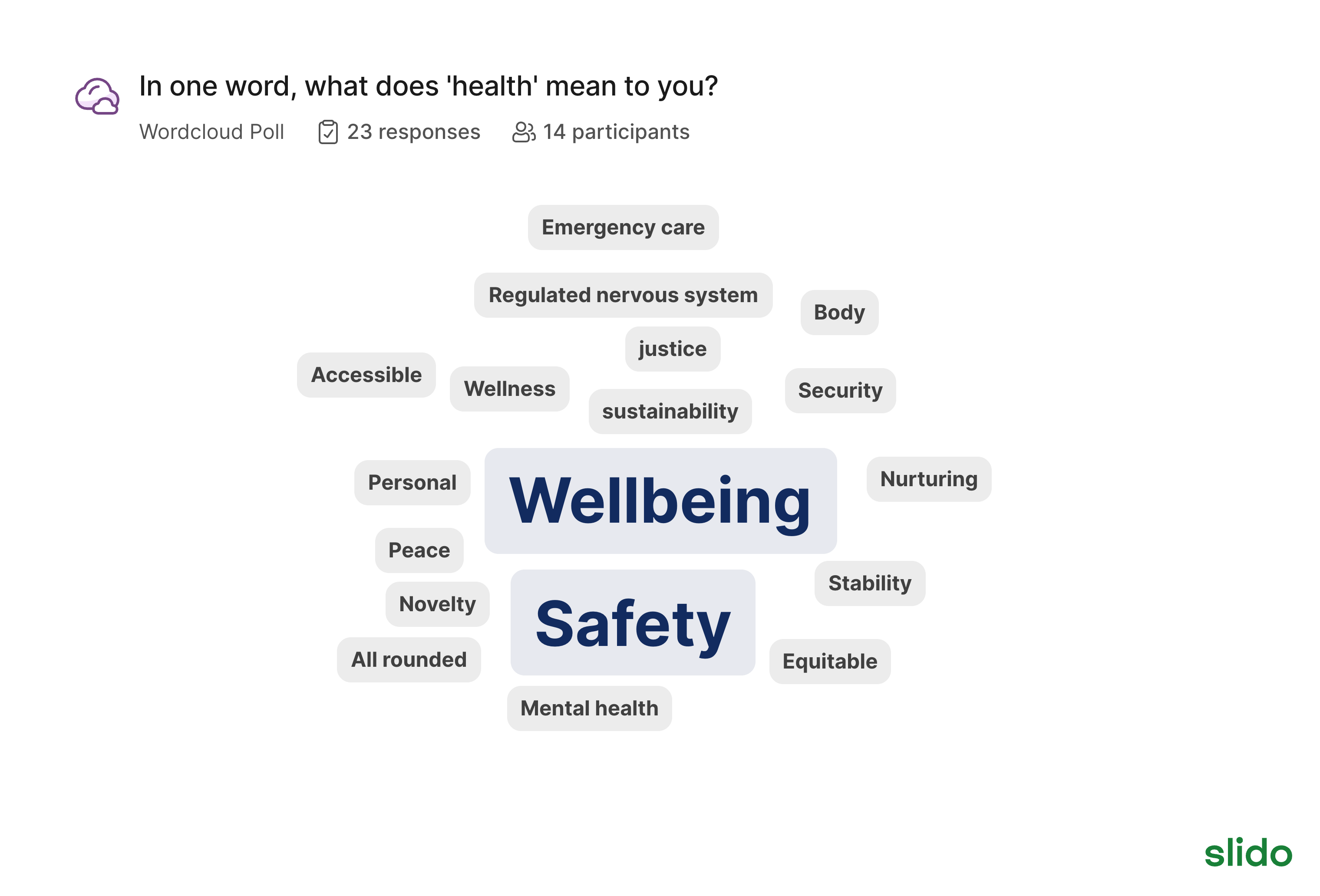
Safety and wellbeing rose to the top, alongside words like equitable, accessible, justice, sustainability, and stability. But some of the most striking entries pointed to something less commonly named in conversations about health: a “regulated nervous system,” “nurturing,” “peace,” “security.” Health, for this room, wasn’t defined narrowly as the absence of illness. It was defined as safety, as steadiness, as being met with care rather than judgment, themes that would echo through every story shared for the rest of the night.
Bearing Witness: Tazakka on Humanitarian Work
Tazakka opened the evening by grounding us in MSF’s founding commitment: to bear witness. To tell the stories of what’s happening on the ground, in refugee camps and service centres, without euphemism and without backing down.
He described MSF’s role as something closer to a reflex than a system, the way a body instinctively pulls back from a cliff edge. It’s meant to be temporary, a stopgap for when a healthcare system has already failed, not a replacement for one. By the time MSF is deployed, he said, you’re already looking at a shipwreck. The real question, the one that matters upstream, is which determinants failed, and why certain populations bear the brunt of that failure more than others.
He didn’t shy away from naming the uncomfortable parts either. The romanticization of humanitarian work, the pull toward photo ops instead of honest documentation, the risk of falling into a white saviour narrative even with good intentions. Drawing on Omar El Akkad’s writing, he noted that the West often imagines itself as the resistance when, in practice, it’s closer to the empire. The work of groups like his campus MSF chapter, he said, is to stay honest about that tension rather than pretend it doesn’t exist.
He closed with something hopeful: young people have real power to shift these systems. He pointed to the 1998 student uprising that helped end a 32-year dictatorship, one his own father took part in, as proof that student movements can move mountains.
Breaking the Silence: Kayowe on FGM/C
Kayowe shared her own experience as a survivor of female genital mutilation and cutting (FGM/C), which occurred during a childhood visit to Somalia. She spoke about the isolation that followed in the years after, including health impacts that are still poorly understood due to a lack of research into women's health, and the difficulty of navigating family expectations that didn't leave room for what she'd been through.
Her work with the End FGM Canada Network centers on making sure survivors are heard. The network connects over 100 survivors across Canada and uses unconventional tools, including a mascot called “Ms. Klitty,” to open conversations that are otherwise avoided out of shame or fear.
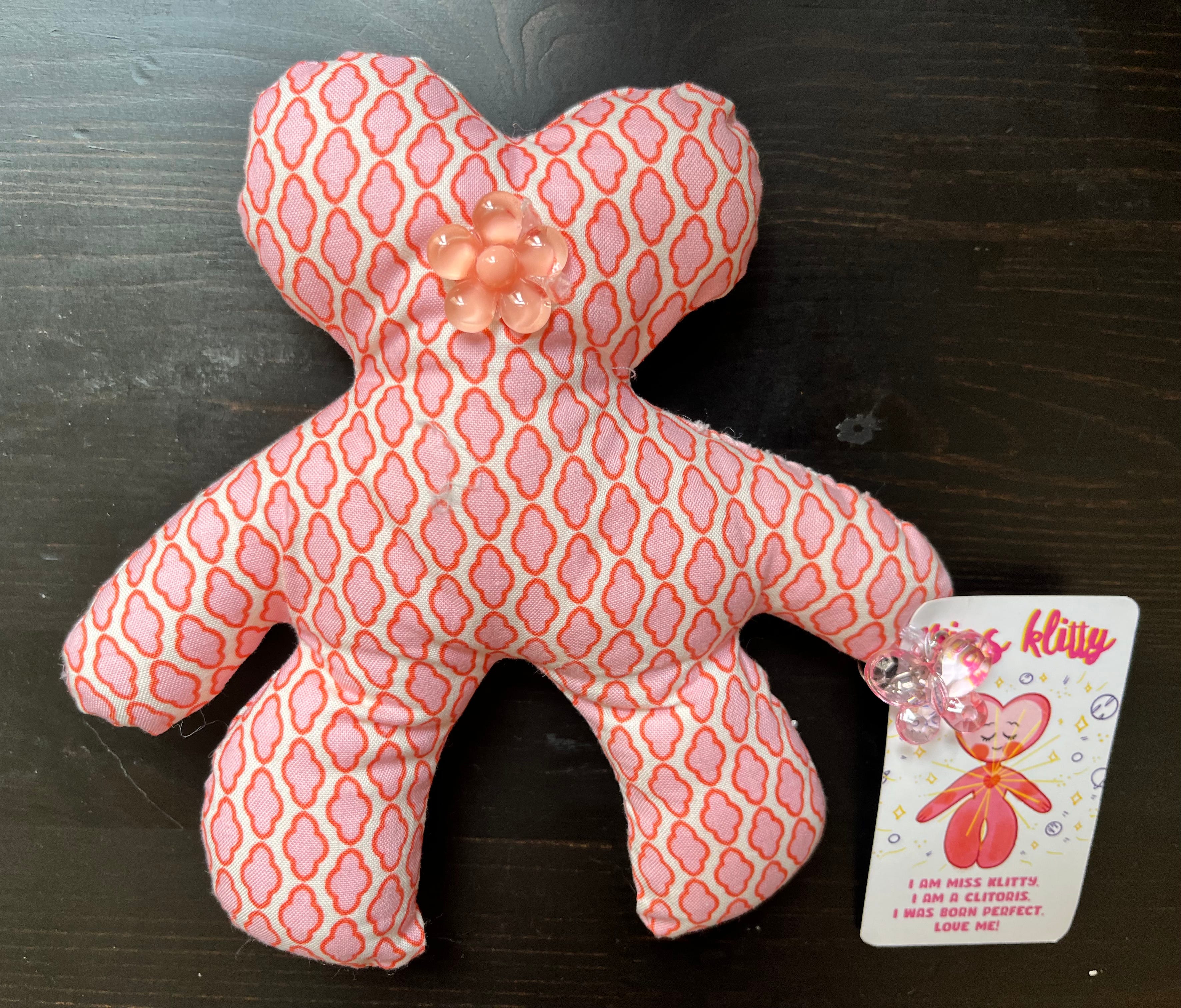
She also spoke about “vacation cutting,” where young girls are told they’re visiting family abroad with no idea what awaits them until they arrive.
Story Circle: What Panelists Are Seeing on the Ground
Question 1: How do you see factors like housing, income, race, gender, immigration, environment or belonging showing up in the health outcomes of the communities you work with?
Panelists spoke from wildly different vantage points, but common threads emerged quickly.
Brendan spoke to belonging in hospice care, describing how family visitation, and by extension, a patient’s final months, often depends on socioeconomic status. Families with more flexibility can visit more, bring grandchildren, stay present. Families working multiple jobs often can’t.
Asha connected environmental and health inequity directly, pointing to Indigenous communities still fighting for access to clean drinking water, and the disproportionate impact of wildfires and flooding on families without the financial means to relocate. She referenced research linking segregation in Black American communities to elevated stress and autoimmune disease rates, and voiced a concern many in the room share: Alberta positioning itself as an AI data centre hub even after a summer of water shortages and conservation measures.
Christine spoke from lived experience of being unhoused as an Indigenous woman, now working within the very systems she once had to navigate. She named housing as a human right and spoke to the stigma still attached to substance use. She shared a story of a man so complex in his needs that staff, afraid to let him go without support, ended up over-medicating him until they found a sustainable path forward. Her closing point stayed with the room: we can build shelters, we can gather resources, but if we’re not building with intention about who they’re for, we’re just building houses, not homes.
Gbemi spoke to the layers underneath every person a system tends to flatten into a single label. Someone isn’t just “a person with an alcohol problem.” There’s income, sexuality, gender identity, and for transgender individuals in particular, the added weight of wondering whether how they present will affect the care they receive.
Nisreen echoed this, noting that the more layers a person carries, the more barriers they tend to face, and that how we show up for people, whether we truly see them or assume we already know who they are, changes everything.
Destiny described the reality facing the four reserves surrounding her community: residents often can’t access care at all, and when they do, they’re sent home without adequate resources, into eight-hour emergency room waits that have become the norm rather than the exception.
Question 2: A story that stays with you
Christine told the story of an individual with a wound severe enough to risk amputation, who wouldn’t let anyone call 911 out of fear rooted in past trauma with the healthcare system. Her team built trust slowly, sitting with them, doing wound care, talking, even as they pushed back in difficult ways at first. Eventually, at a ceremony, they reached for the drumsticks and began to play, and the room went silent. They later came to her organization's grand opening and sang. She called it proof of what's possible when we invest real time in people the system has already written off.
Destiny described a young person navigating a devastating set of losses all at once, a death in the family, parents in crisis, and a depth of grief that made it nearly impossible to leave bed some days. She spoke to how difficult it is to build trust with someone in that state in such a short window, and how much slower and more careful that kind of care has to be.
Brendan recalled working in a clinic at eighteen, treating a peer close to his own age who was navigating the foster care system and showing visible signs of self-harm. He had to send her back into the same circumstances that had brought her in, a moment that felt like watching a cycle repeat itself in real time.
Christine added a reflection on generational trauma, how normalized substance use can become within a family without anyone naming it. Rather than shielding her own children from her family's history, she's chosen to talk to them about it openly, so they understand where certain patterns come from and have another place to put their anger, like the gym, instead of repeating what they don't understand.
Nisreen shared the story of a young Muslim patient from Pakistan on a stroke unit, whose doctors weren’t culturally informed enough to understand that she relied on her mother for major decisions. Being asked what she personally wanted felt foreign, even like a betrayal. Once Nisreen took the time to understand that dynamic, the patient was able to be honest about what she needed and reach a decision she was actually comfortable with.
Asha described a patient facing a serious, advanced illness and a language barrier, whose face lit up the moment Asha addressed in her home language. It was a small moment with real clinical weight: care measurably improves when a patient shares language, culture, or race with their provider. She also spoke about co-founding UBORA after attending a corporate event as one of only two Black women in the room, present but without real influence. Since then, UBORA has helped get six women to a major conference without any of them paying out of pocket, and Asha’s advice to the room was direct: if attending costs you money you don’t have, weigh that cost honestly against the value of being there.
Gbemi closed the circle with an inspiring message of hope - the fact that this conversation was happening at all, and that it was young people facilitating it, was itself a source of hope for her. She asked the room to give itself a round of applause, and it did.
Closing Remarks: Farah on Building a Healthier System Before Illness Begins
Our evening closed with Farah, who brought the room back to where these conversations often need to start: long before someone becomes a patient.
Farah spoke personally about her own path into nursing, tracing it back to her childhood and the experiences that first pulled her toward both climate advocacy and women’s health. That dual thread, environment and gender, has shaped nearly all of her work since: from her role advocating for planetary health education within nursing curricula nationally, to founding the Climate Change + Health Hub Student Council at the University of Alberta, to her current research into the barriers international and immigrant youth face when trying to report sexual assault.
Her closing vision tied the whole evening together. A truly sustainable healthcare system, she argued, can’t just treat illness after it happens. It has to take social determinants of health seriously before people ever become sick, addressing climate change, housing, gender inequity, and access as health interventions in their own right, not afterthoughts. It’s a vision built on the same throughline every panelist had touched on in their own way: that the conditions we’re born into shape our health long before any hospital does.
One Takeaway You’re Leaving With Tonight
We closed the evening with an open-text Slido prompt: one takeaway you’re leaving with tonight.
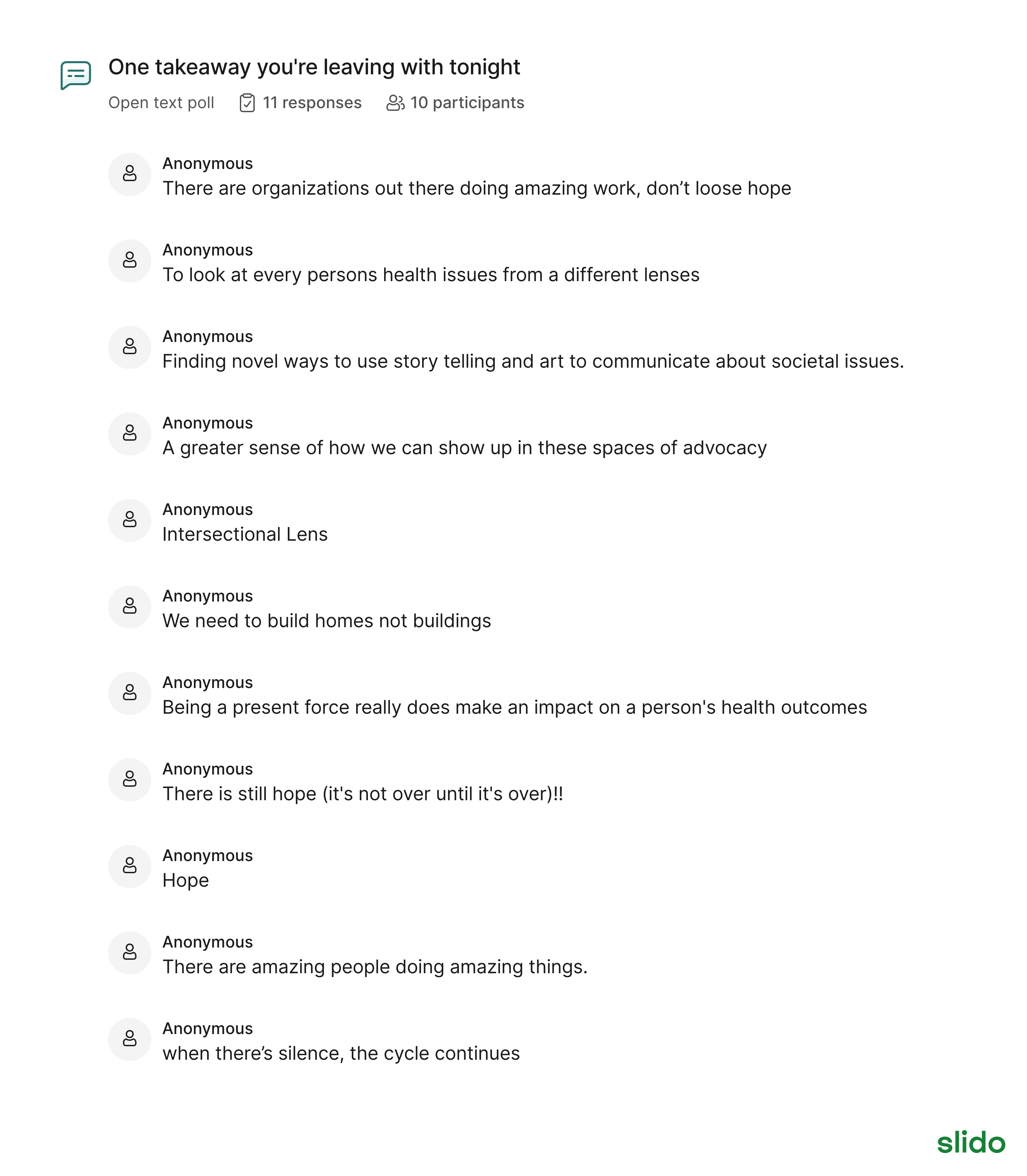
The responses reflected everything the room had just witnessed. Several people wrote simply about hope. Others left with something more instructive: a reminder to lead with an intersectional lens, a renewed sense of how to show up in advocacy spaces, and Christine’s line echoed back almost word for word, “we need to build homes, not buildings.” One response captured something quieter but just as important: “when there’s silence, the cycle continues.” And a few came back to where the evening began: finding new ways to use storytelling and art to talk about the issues that are hardest to name.
Closing Thoughts
If there’s one thread running through everything shared on Friday, and through the room’s own words by the end of the night, it’s this: health was never just clinical. It’s whether someone believes you when you tell them what happened to your body. It’s whether a system sees you as a whole person or as a single label. And even in the hardest parts of this conversation, hope kept surfacing, not as a platitude, but as something the room chose, again and again, to hold onto.
Thank you to every presenter and panelist who trusted our cohort, and our public drop-in guests, with their stories. This is what civic learning looks like when it refuses to look away.
Resources
Interested in learning more about FGM/C? Check out EndFGM’s online modules!
Next Up: Global Citizenship & Systems, Aug 14.